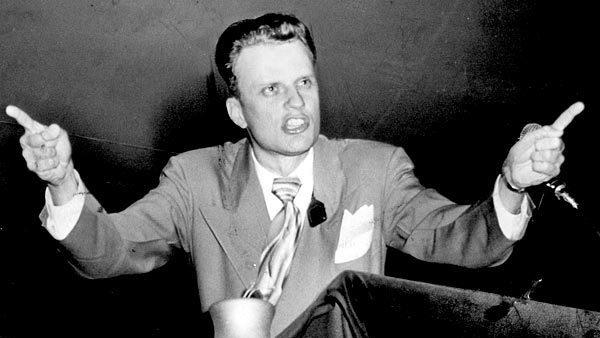
Billy Graham
Billy Graham is a televangelist who rose to fame in the late 1940s. Birthday: Nov. 7, 1918
$25 million
American evangelical Christian evangelist, William Franklin “Billy” Graham, Jr., has a net worth of $25 million. The Southern Baptist evangelist rose to celebrity status as his sermons were broadcast on radio and television.
William Franklin "
Billy"
Graham, Jr. (born November 7, 1918) is an American
evangelical Christian evangelist, ordained as a
Southern Baptist minister, who rose to celebrity status in 1949 reaching a core constituency of middle-class, moderately conservative Protestants. He held large indoor and outdoor rallies; sermons were broadcast on radio and television, some still being re-broadcast today.
[4] In his six decades of television, Graham is principally known for hosting the annual
Billy Graham Crusades, which he began in 1947, until he concluded in 2005, at the time of his retirement. He also hosted the popular radio show
Hour of Decision from 1950 to 1954. He repudiated segregation and, in addition to his religious aims, helped shape the worldview of fundamentalists and evangelicals, leading them to appreciate the relationship between the Bible and contemporary secular viewpoints.
Graham operates a variety of media and publishing outlets.
[7] According to his staff, more than 3.2 million people have responded to the invitation at Billy Graham Crusades to "accept Jesus Christ as their personal savior". As of 2008, Graham's estimated lifetime audience, including radio and television broadcasts, topped 2.2 billion. Because of his crusades, Graham has preached the gospel to more people in person than anyone in the history of Christianity.
[7]
Graham has repeatedly been on
Gallup's list of most admired men and women. He has appeared on the list 60 times since 1955, more than any other individual in the world.
[8] Grant Wacker reports that by the mid-1960s, he had become the "Great Legitimator":
Early life[edit]
William Franklin Graham, Jr. was born on November 7, 1918. He is the eldest of four children born to Morrow (née Coffey; 1892–1981) and William Franklin Graham, Sr. (1888–1962). Graham grew up on a family dairy farm, near
Charlotte, North Carolina, with his two younger sisters and younger brother. In 1927, when he was eight years old, the family moved about 75 yards (69 m) from their white frame house to a newly built red brick home.
[10] He was raised in the
Associate Reformed Presbyterian Church by his parents and is of Scotch-Irish descent.
[11][12] Before this, in 1924, when Graham was only five, he focused on the outdoors, but rarely did he walk, as he was running and zooming, constantly. At the same time, he started as a student at the Sharon Grammar School.
[13] Starting to read books from an early age, Graham loved to read novels for boys, especially
Tarzan. Like Tarzan, he would hang on the trees, and gave the popular Tarzan yell, scaring both horses and drivers. According to his father, that yelling had led him to become a minister.
[14] In 1933, when he was fourteen, as
Prohibition in the United States ended, Graham's father forced him and his sister Katherine to drink beer until they got sick. This created such an aversion that both avoided alcohol and drugs for the rest of their lives.
[15]
After Graham was turned down for membership in a local youth group because he was "too worldly",
[15] Albert McMakin, who worked on the Graham farm, persuaded him to go and see the evangelist
Mordecai Ham.
[7] According to his autobiography, Graham was converted in 1934, at age 16 during a series of revival meetings in Charlotte led by Ham.
[16][17]
After graduating from Sharon High School in May 1936, Graham attended
Bob Jones College, then located in
Cleveland, Tennessee. After one semester, he found it too legalistic in both coursework and rules.
[15] At this time, he was influenced and inspired by Pastor Charley Young from Eastport Bible Church. He was almost expelled, but
Bob Jones, Sr. warned him not to throw his life away: "At best, all you could amount to would be a poor country Baptist preacher somewhere out in the sticks.... You have a voice that pulls. God can use that voice of yours. He can use it mightily."
[15]
On August 13, 1943, Graham married Wheaton classmate
Ruth Bell (1920–2007), whose parents were Presbyterian missionaries in China. Her father,
L. Nelson Bell, was a general surgeon.
[20] Ruth Graham died on June 14, 2007, at the age of 87. The Grahams were married almost 64 years.
Graham and his wife had five children together: Virginia Leftwich (Gigi) Graham (born 1945; an inspirational speaker and author);
Anne Graham Lotz (born 1948; runs AnGeL ministries); Ruth Graham (born 1950; founder and president of Ruth Graham & Friends, leads conferences throughout the U.S. and Canada);
Franklin Graham (born 1952), who serves as president and CEO of the
Billy Graham Evangelistic Association and as president and CEO of international relief organization,
Samaritan's Purse;
[21] and Nelson Edman Graham (born 1958; a pastor who runs East Gates Ministries International,
[22] which distributes Christian literature in China).
Ministry career[edit]
While attending college, Graham became pastor of the United Gospel Tabernacle and also had other preaching engagements.
Graham served briefly as pastor of the First Baptist Church in
Western Springs, Illinois, not far from Wheaton, in 1943–44. While there, his friend [Torrey Johnson], pastor of the Midwest Bible Church in [Chicago], told Graham that his radio program,
Songs in the Night, was about to be canceled due to lack of funding. Consulting with the members of his church in Western Springs, Graham decided to take over Johnson's program with financial support from his congregation. Launching the new radio program on January 2, 1944, still called
Songs in the Night, Graham recruited the
bass-baritone George Beverly Shea as his director of radio ministry. While the radio ministry continued for many years, Graham decided to move on in early 1945. In 1947, at age 30, he was hired as president of
Northwestern Bible College in
Minneapolis—at the time, the youngest person to serve as a sitting president of any U.S. college or university. Graham served as the president from 1948 to 1952.
[26]
Initially, Graham intended to become a
chaplain in the
armed forces but, shortly after applying for a commission, contracted
mumps. After a period of recuperation in
Florida, he was hired as the first full-time
evangelist of the new
Youth for Christ (YFC), co-founded by Torrey Johnson and the Canadian evangelist
Charles Templeton. Graham traveled throughout both the United States and Europe as an YFCI evangelist. Unlike many evangelists, he had little formal theological training. Templeton applied to
Princeton Theological Seminary for an advanced theological degree and urged Graham to do so as well, but he declined as he was already serving as the president of Northwestern Bible College.
[15][26]
Graham scheduled a series of
revival meetings in
Los Angeles in 1949, for which he erected circus tents in a parking lot.
[7] He attracted national media coverage, especially in the conservative
Hearst chain, although Hearst and Graham never met.
[27] The crusade event ran for eight weeks—five weeks longer than planned. Graham became a national figure with heavy coverage from the wire services and national magazines.
[28]
Crusades[edit]
Since his ministry began in 1947, Graham conducted more than 400 crusades in 185 countries and territories on six continents. The first Billy Graham Crusade, held September 13–21, 1947, in the Civic Auditorium in Grand Rapids, Michigan, was attended by 6,000 people. Graham was 28 years old. He called them crusades, after the medieval Christian forces who conquered Jerusalem. He would rent a large venue, such as a stadium, park, or street. As the sessions became larger, he arranged a group of up to 5,000 people to sing in a choir. He would preach the
gospel and invite people to come forward (a practice begun by
Dwight L. Moody). Such people were called inquirers and were given the chance to speak one-on-one with a counselor, to clarify questions and pray together. The inquirers were often given a copy of the
Gospel of John or a
Bible study booklet. In
Moscow, in 1992, one-quarter of the 155,000 people in Graham's audience went forward at his call.
[15] During his crusades, he has frequently used the
altar call song, "
Just As I Am".
[29]
Graham was offered a five-year, $1 million contract from
NBC to appear on television opposite
Arthur Godfrey, but he turned it down in favor of continuing his touring revivals because of his prearranged commitments.
[20] Graham had missions in
London, which lasted 12 weeks, and a
New York City mission in
Madison Square Garden in 1957, which ran nightly for 16 weeks.
Student ministry[edit]
At each Urbana conference he challenged the thousands of attendees to make a commitment to follow Jesus Christ for the rest of their lives, often quoting a 6-word phrase written in the Bible of an heir to the Borden milk fortune, William Borden, who died in Egypt on his way to the mission field, "no reserves, no retreat, no regrets".
[31]
Graham also held evangelistic meetings on a number of college campuses: at the University of Minnesota during InterVarsity's "Year of Evangelism" in 1950–51, a 4-day mission at Yale University in 1957, and a week-long series of meetings at the University of North Carolina's Carmichael Auditorium in September 1982.
[32]
In 1955 he was invited by students to lead the mission to Cambridge University, arranged by the
CICCU, with the London pastor-theologian
John Stott as his chief assistant. This invitation was greeted with much disapproval in the correspondence columns of
The Times.
[33]
Evangelistic association[edit]
- Hour of Decision, a weekly radio program broadcast around the world for more than 50 years
- Mission television specials broadcast in almost every market in the US and Canada
- A syndicated newspaper column, My Answer, carried by newspapers across the United States and distributed by Tribune Media Services
- Decision magazine, the official publication of the association
- Christianity Today was started in 1956 with Carl F. H. Henry as its first editor
- Passageway.org, the website for a youth discipleship program created by BGEA
- World Wide Pictures, which has produced and distributed more than 130 films
In April 2013, the Billy Graham Evangelistic Association started "My Hope With Billy Graham", the largest outreach in its history, encouraging church members to spread the gospel in small group meetings after showing a video message by Graham. "The idea is for Christians to follow the example of the disciple Matthew in the New Testament and spread the gospel in their own homes."
[34] The video, called "The Cross", is the main program in the My Hope America series and was also broadcast the week of Graham's 95th birthday. In an email interview with WND, Graham wrote that "we are close to the end of the age".
[35]
Civil rights movement[edit]
During a 1953 rally in Chattanooga, Tennessee, Graham tore down the ropes that organizers had erected to separate the audience into racial sections. He recounted in his memoirs that he told two ushers to leave the barriers down "or you can go on and have the revival without me."
[36] He warned a white audience, "we have been proud and thought we were better than any other race, any other people. Ladies and gentlemen, we are going to stumble into hell because of our pride."
[37]
In 1957, Graham's stance towards integration became more publicly shown when he allowed African American ministers Thomas Kilgore and
Gardner Taylor to serve as members of his New York Crusade's executive committee
[38] and invited the Rev.
Martin Luther King, Jr., whom he first met during the
Montgomery Bus Boycott in 1955,
[38] to join him in the pulpit at his 16-week revival in New York City, where 2.3 million gathered at
Madison Square Garden,
Yankee Stadium, and
Times Square to hear them.
[7] Graham recalled in his autobiography that during this time, he and King developed a close friendship and that he was eventually one of the few people who referred to King as "Mike," a nickname which King asked only his closest friends to call him.
[39] Following King's assassination in 1968, Graham mourned that America had lost "a social leader and a prophet".
[38] In private, Graham would also advise King and other members of the
Southern Christian Leadership Conference (SCLC).
[40]
Despite their friendship, tensions between Graham and King emerged in 1958 when the sponsoring committee of a crusade which took place in San Antonio, Texas on July 25 arranged for Graham to be introduced by that state's segregationist governor,
Price Daniel.
[38] On July 23, King sent a letter to Graham and informed him that allowing Daniel to speak at a crusade which occurred the night before the state's Democratic Primary "can well be interpreted as your endorsement of racial segregation and discrimination."
[41] Graham's advisor, Grady Wilson, replied to King that "even though we do not see eye to eye with him on every issue, we still love him in Christ."
[42] Though Graham's appearance with Daniel dashed King's hopes of holding joint crusades with Graham in the Deep South,
[40] the two still remained friends and King told a Canadian television audience the following year that Graham had taken a "very strong stance against segregation."
[40] Graham and King would also come to differ on the Vietnam War.
[38] After King's "Beyond Vietnam" speech denouncing U.S. intervention in Vietnam, Graham castigated him and others for their criticism of American foreign policy.
[38]
By the middle of 1960, King and Graham traveled together to the Tenth Baptist World Congress of the Baptist World Alliance.
[38] In 1963, Graham posted bail for King to be released from jail during the
civil rights protests in Birmingham.
[43] Graham held integrated crusades in Birmingham, Alabama, on Easter 1964 in the aftermath of the bombing of the Sixteenth Street Baptist Church, and toured Alabama again in the wake of the violence that accompanied the first Selma to Montgomery march in 1965.
[38]
Graham's faith prompted his maturing view of race and segregation; he told a member of the
KKK that integration was necessary primarily for religious reasons: "there is no scriptural basis for segregation", Graham argued, "The ground at the foot of the cross is level, and it touches my heart when I see whites standing shoulder to shoulder with blacks at the cross."
[44]
Lausanne Movement[edit]
The friendship between Graham and John Stott led to a further partnership in the
Lausanne Movement, of which Graham was founder. It built on Graham's 1966
World Congress on Evangelism in Berlin.
[clarification needed] In collaboration with
Christianity Today, Graham convened what
TIME magazine described as "a formidable forum, possibly the widest–ranging meeting of Christians ever held"
[45] with 2,700 participants from 150 nations gathering for the
International Congress on World Evangelization. This took place in Lausanne, Switzerland (July 16–25, 1974), and the movement which ensued took its name from the host city. Its purpose was to strengthen the global church for world evangelization, and to engage ideological and sociological trends which bore on this.
[46] Graham invited Stott to be chief architect of the
Lausanne Covenant, which issued from the Congress and which, according to Graham, "helped challenge and unite evangelical Christians in the great task of world evangelization."
[47] The movement remains a significant fruit of Graham's legacy, with a presence in nearly every nation.
[48]
Illness[edit]
https://www.facebook.com/ReverendBillyGraham/
Nehanda Radio's List:
- Bishop T.D. Jakes - net worth $150
- Bishop David Oyedepo - net worth - $150 million
- E A Adeboye
- Benny Hinn - net worth $42 million
- Chris Oyakhilome - net worth $30 to $50 million
- Creflo Dollar
- Kenneth Copeland
- Billy Graham - net worth $25 million (note: this amount is questionable, see below)
- Matthew Ashimolowo - annual income $200,000
- Temitope Joshua - net worth $10 million to $15 million